Solar installers
Prompts for Solar Installers: 10 Ready-to-Use Prompts That Save Time Today
By Samuel Michelot · Updated September 2026
Short answer
You do not need to study prompt engineering to get useful AI output in a solar business. These ten prompts cover the most common daily tasks: drafting follow-up messages, answering customer questions, preparing quotes and proposals, planning site visit questions, and explaining financing. The two rules that matter: give the AI the real context from your job (location, system size, roof type, your notes) and check every number and technical claim before it reaches a customer. AI drafts, you verify.
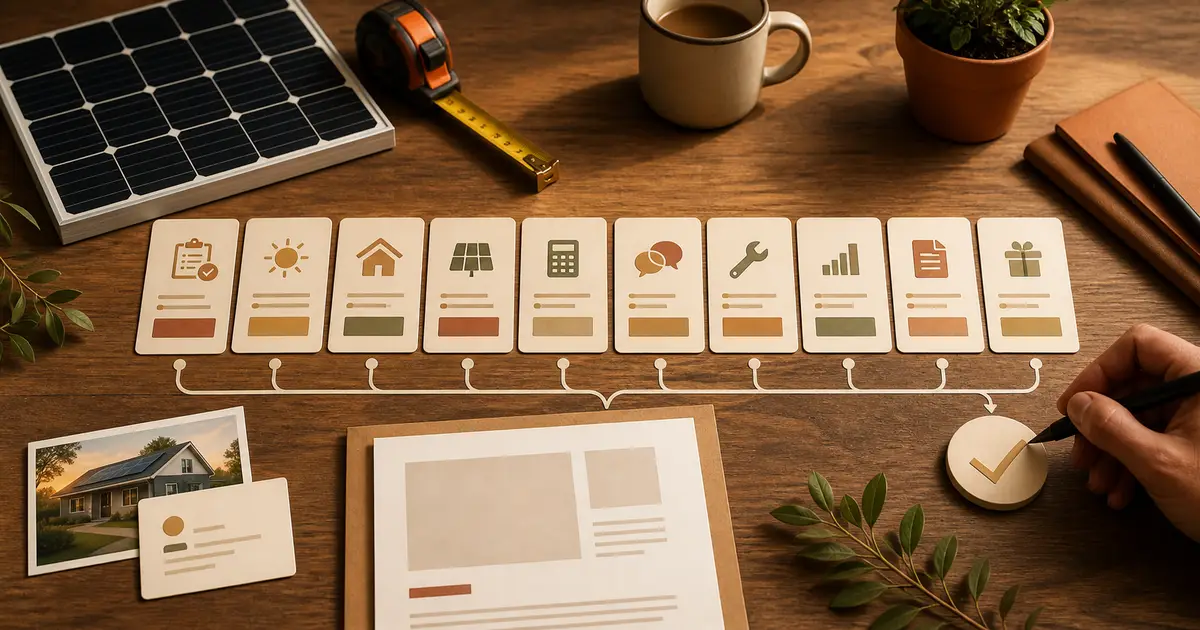
You have probably heard that AI can help your solar business, then opened a chat tool and got a generic answer that was not quite right. The gap is not your ability to write prompts, it is the missing context and the missing verification step.
This guide gives you ten prompts that work for the daily tasks of an installer, plus the two rules that keep the output accurate enough to send.
The two rules that matter
Before the prompts, the two rules that turn AI from a toy into a tool:
- Give real context. Paste the customer’s location, system size, roof type and your own notes. The output is only as good as the input.
- Verify before sending. AI drafts, you check. Especially numbers, prices and anything about local rules or incentives.
With those two rules, the prompts below will save you real time today.
Ten prompts for daily solar tasks
1. Quote follow-up message
I sent a quote to a homeowner in [city] for a [size] kW system on a [roof type]. It has been 6 days with no reply. Write a short, warm follow-up email that mentions their specific project, offers one clear next step (call, financing, or a question answered) and does not sound pushy. Under 100 words.
2. Answer a customer’s technical question
A customer asked: “[paste their question, e.g. what happens on cloudy days]”. Answer in plain language for a homeowner, 5 sentences max, and do not invent numbers I have not given you. If you need a real number, say I should fill it in.
3. First proposal draft
Draft the introduction and summary sections of a proposal for a [size] kW residential solar system in [city]. Include: estimated annual production [kWh], estimated first-year savings [amount], the components we install, and a warranty summary. Keep the tone clear and confident. Leave numbers as placeholders for me to verify.
4. Site visit questions
I am visiting a homeowner in [city] to assess their roof for solar. The roof is [material/age/shape]. Generate a checklist of questions to confirm: electricity consumption, shading, panel placement, battery interest, financing preference and decision timeline. Keep it under 15 items.
5. Financing explanation for a customer
Explain to a homeowner, in plain language, how [financing option, e.g. a 12-year loan with an energy bill offset] works for a [size] kW system in [country/region]. Include the rough monthly payment as a placeholder and the key benefit in one sentence. Do not state incentives unless I confirm them.
6. Reply to a “too expensive” objection
A customer says my quote is more expensive than another installer. Draft a reply that: acknowledges the price, lists the differences in equipment and warranty we offer, and asks one question to understand their comparison. Warm, not defensive, under 120 words.
7. Social media post about a finished install
Write a short LinkedIn post about a completed [size] kW install on a [roof type] roof in [city]. Mention the production estimate, a one-line customer benefit, and end with a soft call to action for local homeowners. 80 words, natural tone.
8. Estimate of savings for a new lead
Based on: location [city], monthly consumption [kWh], current tariff [amount per kWh], roof type [type]. Draft a simple savings estimate I can send to a lead, with placeholder numbers where you are unsure, and list exactly what data I need to make it accurate.
9. Internal job summary after a site visit
Summarize my site visit notes for a potential install in [city]: roof condition, shading issues, recommended system size, battery yes/no, customer concerns, and next steps. Use bullet points, keep my notes verbatim where possible, and flag anything unclear.
10. Follow-up after a no-response deadline
A lead in [city] requested a quote [date] and has not responded since my two follow-ups. Draft one final message that asks whether their timeline changed, offers to adjust the quote, and leaves the door open. Under 80 words, no guilt.
How to use them in your workflow
These prompts replace the slow part of drafting, not the review. The full system works best when combined: use these for the message, your AI-prepared quotes for the proposal, and automated follow-ups for the timing. In each case, the prompt is the input and your verification is what keeps it safe to send.
The payoff
The first week, these prompts will save you the minutes spent staring at a blank reply. Over a month, they remove the resistance to following up at all, which is where solar deals are won or lost. And because you verify every output, you get the speed without the risk.
To implement complete automated systems and operational templates for your solar business, visit our AI training for solar installers program.
Frequently asked questions
Do I need to learn prompt engineering to use AI well?
No. For most solar business tasks, the difference between a good and a poor prompt is context, not technique. Paste your real job details into the prompt, ask for a specific output, and review it. A few simple prompts reused daily beat hours of prompt-engineering theory.
Can I trust AI to answer technical customer questions?
You can use it to draft an answer, but you must verify the numbers and any technical or regulatory claims before sending. AI can sound confident and be wrong, especially on local rules, prices and incentives. The rule: AI drafts, you verify.
What is the biggest mistake installers make with AI prompts?
Using generic prompts with no real context, then sending the output without checking it. A prompt that includes your customer's actual project details produces a useful message; a vague prompt produces generic fluff, and sending unverified numbers damages trust.
How do these prompts fit with my workflow?
They slot into the same workflow as [AI-prepared solar quotes](/blog/ai-solar-quotes/) and [automated follow-ups](/blog/ai-solar-followup/). The prompt is the input, your review is the safety net, and the output saves the manual drafting time in between.
Want this inside your own business?
Simple AI Studio runs a hands-on implementation bootcamp for founders and small teams. You leave with a working AI system, not slides.