Solar installers
Using AI to prepare better solar quotes
By Samuel Michelot · Updated June 2026
Short answer
Instead of manually typing each quote from scratch, use AI to: (1) extract details from the site visit photos/notes, (2) draft the technical proposal auto-populated with common parts/labor items, (3) calculate financing options and government subsidies, (4) generate a professional PDF. You go from 2 hours per quote to 30 minutes. The customer still needs to review it, but AI handles the repetitive data entry and calculations.
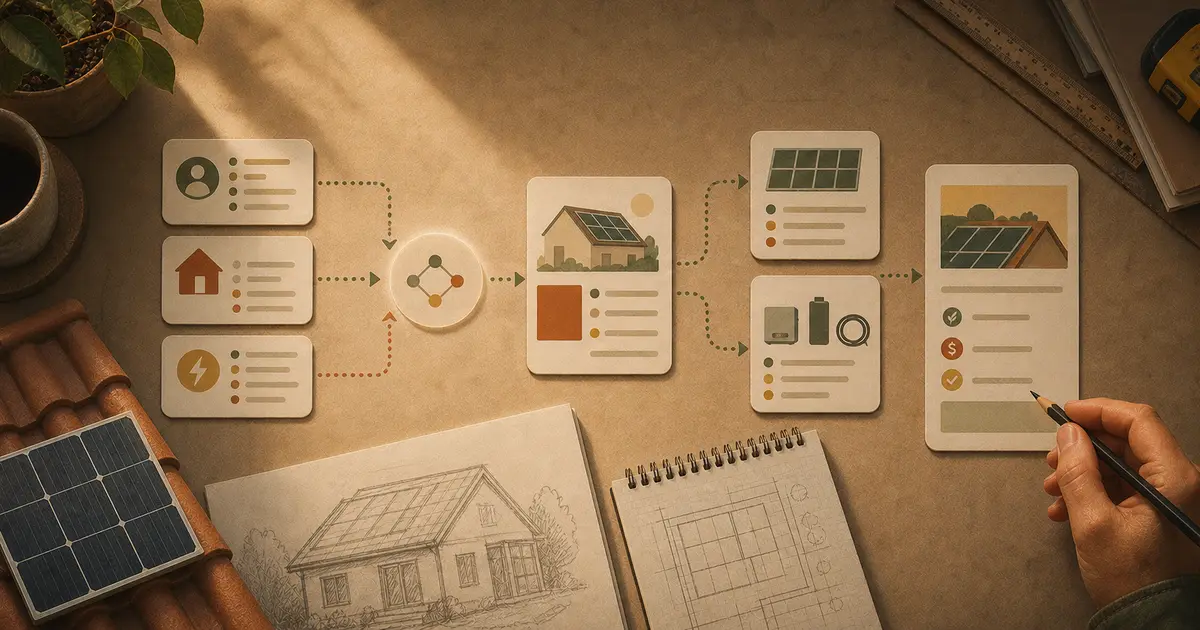
Solar installation projects start with a quote. Getting the quote right matters: customers compare prices, understand the subsidy landscape, and make a decision. But quote preparation is brutal: site photos, measurements, electric plan review, equipment specs, local subsidies, financing calculations, PDF generation. Most installers spend 2–4 hours per quote.
This guide shows how AI can cut that in half while making the result better—not by making you less expert, but by automating the data entry and calculations so you can focus on the actual solar design.
The solar quote workflow (where AI fits)
A typical quote has these steps:
- Collect site data. Photos, measurements, roof condition, electric usage, current bills.
- Design the system. kW needed, panel layout, inverter choice, wiring.
- Source equipment. Find specific panels, inverters, and hardware. Get current prices.
- Calculate production. Estimate annual generation based on location and tilt.
- Estimate subsidies. What government/local programs apply? What’s the customer eligible for?
- Calculate ROI. Cost, savings, payback period, 25-year NPV.
- Offer financing options. Cash, loan, leasing, energy-savings agreement.
- Format into a proposal. Professional PDF with branding, terms, signatures.
Without AI, you do all of this. With AI, you can automate steps 3, 4, 5, 6, 8, and part of 7. Steps 1, 2, and your expertise stay with you.
How to use AI for solar quotes: a practical workflow
Phase 1: Extract from site visit (ChatGPT or Claude)
After your site visit, you have photos and notes. Feed these to AI:
Prompt: “From these photos and notes, extract the key info: roof area, shade conditions, electric usage from the customer’s bill, roof direction and tilt, any obstacles. Here’s the format I need: [template]”
Output: A structured table with all the site data pre-filled. You correct it if AI misread something, then move to the next step.
Time saved: 15 minutes of manual data entry.
Phase 2: Generate equipment proposal (custom tool or API)
Create or connect to a tool that says: “For a [kW] system in [location] with [roof direction], here are the recommended panels, inverters, and costs from our suppliers.”
This is hardest part to automate because it needs real-time inventory and pricing. Options:
- No code: Build a simple Airtable base that links your equipment to system size and location. Use a Zapier automation to pull recommendations.
- Code: Use an API-based approach if your suppliers have data feeds (Fronius, SMA, etc.).
- Hybrid: Keep a spreadsheet of your top 3–5 configurations (3kW, 5kW, 8kW, 10kW). Use AI to match the customer’s need to a configuration, then fill in current prices.
Output: A full bill of materials with costs.
Time saved: 45 minutes of parts research + pricing.
Phase 3: Calculate production and ROI (spreadsheet + AI)
Use a tool like PVWatts (free from NREL) to estimate annual generation. Then feed this to AI or a spreadsheet:
Prompt: “Customer’s current bill is €X/year. System generates Y MWh/year at current market price of €Z/MWh. What’s the annual savings, payback period, and 25-year NPV at 3% discount rate?”
Output: Financial projections in the format you use for proposals.
Time saved: 30 minutes of financial calculation.
Phase 4: Subsidy research (AI + your subsidy list)
This is manual, but you can systematize it. Create a document listing all subsidies you work with:
“Catalonia: Activa program (€100/kW up to €5k), Renting program (covers 40% with 0% financing). Spain: Fondo de Carbono (€2,400 for residential, needs demo). EU: EPBD energy improvements (up to €50k, needs certification).”
Then ask AI: “For a customer in [location] installing a [size] system, which subsidies apply and what’s the estimated benefit?”
AI will cross-reference your list and estimate. You verify and update as programs change.
Time saved: 20–30 minutes of subsidy research per quote.
Phase 5: Draft the proposal PDF (template + AI)
Use a proposal template (Canva, Word, or PDF tool) and have AI fill it in:
Prompt: “Using this template, draft a professional solar proposal with: [site data], [equipment list], [financial projections], [subsidy info]. Format in [template].
Output: A draft PDF ready to review.
You open it, check the numbers, add any personal notes (“As discussed, we can adjust the layout to avoid the chimney”), sign, and send.
Time saved: 30–45 minutes of document formatting.
Putting it together: the 2-hour quote becomes 30 minutes
Old workflow (2–4 hours per quote):
- Extract data from photos: 15 min
- Research equipment, pricing: 45 min
- Design system, calculate production: 30 min
- Estimate subsidies: 30 min
- Calculate ROI, financing: 30 min
- Format proposal: 45 min
- Review and adjust: 15 min Total: 3.5 hours
With AI (30 minutes per quote):
- Extract data (AI): 5 min (you verify)
- Equipment proposal (tool): 5 min (you verify)
- Production + ROI (AI): 5 min (you verify)
- Subsidies (AI reference): 5 min (you verify)
- Draft proposal (AI template): 5 min (you review and adjust) Total: 25 minutes
The time you save: quote back to customer in 24 hours instead of 3 days. Customers respond better to that responsiveness. You can handle 2x more quote requests without hiring.
Why this still needs your expertise
AI handles:
- Data entry and calculation (error-prone, slow)
- Format consistency (professional presentation)
- Cross-referencing (which subsidy applies?)
You handle:
- Site design (AI can’t see roof complexity)
- Equipment choices (AI doesn’t know your supplier relationships)
- Customer conversation (AI doesn’t know their budget or preferences)
- Final review (AI makes mistakes; you catch them)
This is not replacing an installer. It’s giving an installer more time to do what they’re actually good at instead of typing up PDFs.
Getting started
- Pick one proposal from the last 3 months. Use it as a template.
- Feed it to ChatGPT with this prompt: “I’ll give you a customer solar quote I created. Learn its structure, calculations, and format. Then, if I describe a new customer’s site, draft a similar quote.”
- Try it on one real customer. See how long it takes. Adjust based on what you learned.
- Build the subsidy list. Document all programs you work with and the rules. This is the one time investment that keeps paying off.
- Integrate with your CRM or email. So when a customer request arrives, the quote process is one workflow, not five different apps.
Next steps
Read why SOPs come before automation to think through your exact quote process before automating it. Clear process makes AI work better.
Also check measuring if AI training actually saves time to track whether this setup actually saves your team hours like we predict.
Frequently asked questions
If AI generates the quote, how do I make sure the numbers are right?
You check them. AI is fast at data entry and calculation, but solar involves specific subsidies, roof conditions, and local regulations. You spend 30 minutes reviewing and adjusting a draft instead of 2 hours building from scratch. You're still the expert; AI just does the busywork.
Our quotes are very customized. Will AI understand our specifics?
Train the AI on your past quotes. Upload 5–10 of your best proposals as examples. Tell it your standard package options, typical pricing, and local subsidy rules. Then it learns your specific approach. You still customize, but from a solid draft instead of a blank page.
What about subsidies and financing? Those change constantly.
That's the hardest part. AI can calculate based on rules you give it ('in Catalonia, the Activa program gives X% up to Y amount'). But when programs change, you need to update the rules. Ideally, build a simple spreadsheet or tool that calculates this, then pull those numbers into your AI draft.
Don't customers expect a personal touch, not an AI draft?
They expect a professional, accurate quote quickly. If it takes you 2 hours and they wait 3 days, that's not personal—that's slow. If you deliver a polished draft in 24 hours (AI-drafted, you-reviewed), they see responsiveness. You still add your personal note, visit notes, and expert opinion.
Want this inside your own business?
Simple AI Studio runs a hands-on implementation bootcamp for founders and small teams. You leave with a working AI system, not slides.