Solar installers
The Quote Is Not the Sale: Build a Solar Follow-Up System That Does Not Depend on Memory.
By Samuel Michelot · Updated June 2026
Short answer
Sending a technical quote is only 20% of the sale. Most solar installation companies lose qualified deals because follow-up depends on the memory of busy technicians. Build a 5-stage follow-up cadence where AI drafts personalized messages referencing real roof data and savings calculations, categorizes incoming replies, and alerts sales leads when a prospect is ready to sign.
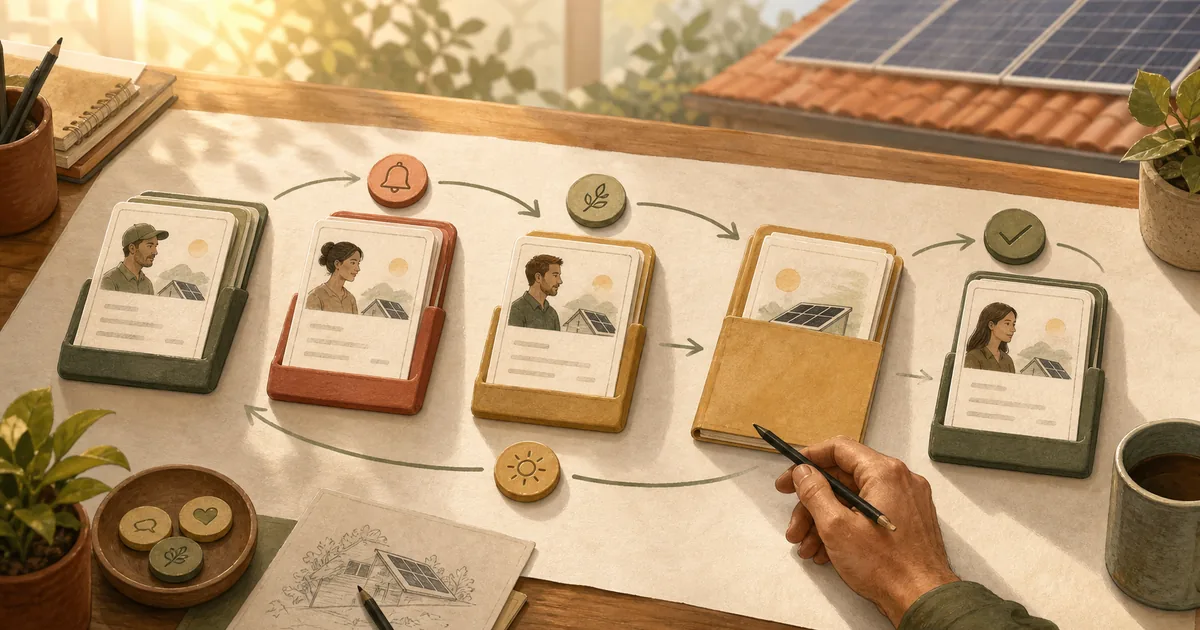
You complete a thorough technical site survey, calculate panel layouts, and send a 15-page photovoltaic proposal to a homeowner. Then silence.
The sales rep assumes the customer will call if they have questions. The installer gets busy on a roof installation. Two weeks pass, the quote gets buried under fresh inquiries, and the homeowner eventually signs with a competitor who called them three times with clear answers.
The mistake is thinking the customer will decide alone. The quote is not the sale. Most installers do not lose deals because of their technical engineering; they lose deals because follow-up is inconsistent, delayed, and dependent on memory.
The right first move is building an automated 5-stage follow-up cadence that runs on clear operational triggers.
The 5 Stages of a High-Closing Solar Follow-Up
Every prospective solar buyer moves through five distinct psychological checkpoints after receiving a quote:
[Stage 1: Quote Sent] ──> [Stage 2: 48h Check-In] ──> [Stage 3: Objections]
                                                              │
[Stage 5: Clean Close / Archive] <── [Stage 4: Decision Push] <┘
Stage 1: Quote Sent & Delivery Confirmation
- Goal: Ensure the customer received the proposal and understands the 1-page executive summary.
- Trigger: Proposal emailed from your CRM or ERP.
- Data Needed: Homeowner name, system size (kWp), estimated first-year savings, proposal PDF link.
- Message Type: WhatsApp or short email with a 3-bullet summary (Total investment, estimated annual savings, payback period).
- Owner: Automated dispatch.
Stage 2: First Confirmation (48 Hours Post-Quote)
- Goal: Verify that the homeowner reviewed the numbers and identify immediate doubts.
- Trigger: T+48 hours with no reply.
- Data Needed: Specific roof orientation, battery option status.
- Message Type: Personal check-in: “Hi [Name], just checking if you had a chance to review the 5.4 kWp layout. Did the estimated 65% grid independence match what you had in mind?”
- Owner: AI-drafted, 1-click human review.
Stage 3: Answering Common Technical Objections (Day 5 to 7)
- Goal: Resolve unvoiced fears about roof drilling, battery ROI, or winter production.
- Trigger: T+6 days without decision.
- Data Needed: Roof type (tile, metal, flat deck), battery inclusion.
- Message Type: Educational value touch: A 1-page FAQ addressing the exact structural mounting system used on their roof type.
- Owner: Automated sequence with link tracking.
Stage 4: Decision Support & Installation Scheduling (Day 12 to 14)
- Goal: Create gentle urgency around installation team availability and local administrative processing.
- Trigger: T+12 days.
- Data Needed: Upcoming installation calendar slots, municipal rebate deadlines.
- Message Type: Action-oriented: “We are currently locking in installation dates for next month. If you want to proceed with the 5.4 kWp system, let me know by Thursday so we can reserve your slot.”
- Owner: Sales lead phone call or personal WhatsApp.
Stage 5: Reactivation or Clean Close (Day 21)
- Goal: Either re-engage the prospect or archive the deal to keep your CRM clean.
- Trigger: T+21 days with no response.
- Data Needed: Project reference code.
- Message Type: Permission to close: “Since I have not heard back, I assume your solar plans are on pause for now. I will close this file to avoid cluttering your inbox. Feel free to reach out whenever you are ready.”
- Owner: Automated final message; auto-updates CRM stage to “Closed - Inactive”.
Where AI Accelerates the Pipeline
AI should not replace your commercial relationships. It should remove the clerical friction so your sales lead can focus on closing:
- Drafting Hyper-Personalized Messages: AI ingests site survey notes (e.g., “Customer worried about shade from oak tree on east side”) and drafts a custom message addressing that exact concern.
- Categorizing Incoming Responses: When a customer replies, AI reads the email and tags it:
Price Objection,Financing Request,Ready to Sign, orTechnical Question. - Flagging Hot Leads for Instant Calls: If a prospect replies asking about installation dates, AI immediately alerts the founder or sales lead via Slack/WhatsApp with a suggested phone script.
- Automating CRM Logging: AI summarizes email exchanges and logs them directly into your database (STEL Order, Odoo, HubSpot), keeping records pristine without manual data entry.
Where AI Must NEVER Act Alone
Set firm boundaries in your company instruction manual (AGENTS.md):
- Custom Price Discounts: AI must never negotiate margins or offer discounts autonomously.
- Unverified Technical Promises: AI must never alter inverter sizing or promise production figures not validated by your technical survey.
- Contract Signatures: Formal agreements require explicit customer signature and human verification.
- Customer Conflict: Any dissatisfied or angry reply must be routed directly to the business owner immediately.
Keep It Respectful and Permission-Based
Under European privacy standards (GDPR and LSSI), you are communicating with prospects who explicitly requested a quote. Keep your follow-ups professional and compliant:
- Only follow up regarding the specific solar study they requested.
- Always include an effortless way to opt out (e.g., “Reply ‘pause’ if you want us to stop messaging”).
- Respect opt-outs instantly by updating your CRM status automatically.
The 14-Day Implementation Sprint for Installers
You can roll out this entire follow-up engine in two weeks:
- Days 1 to 3: Audit your last 30 sent quotes. Count how many received more than two follow-up messages.
- Days 4 to 7: Draft your 5-stage message templates and store them in your company Second Brain.
- Days 8 to 10: Connect your CRM quote triggers to your AI drafting tool.
- Days 11 to 14: Train your sales team to review and approve AI-generated drafts in under 30 seconds per lead.
To improve your upfront proposals before follow-up starts, read our guide on using AI to prepare better solar quotes.
If your team has this problem, this is what we work on in a practical AI training for solar installers. We help you build automated follow-up cadences, connect your CRM tools, and train your staff to close more installations without working longer hours.
Frequently asked questions
Will automated follow-up messages feel spammy to homeowners?
Generic follow-ups that say 'just checking in' feel like spam. Contextual follow-ups that reference the homeowner's specific 6 kWp roof layout, their estimated annual electricity savings, and local municipal tax rebates feel like professional advisory service. Specificity creates trust.
Can AI update our solar CRM or ERP automatically?
Yes. When connected through standard webhooks or platform tools (such as Zapier, Make, or native API connectors in tools like STEL Order, Odoo, or HubSpot), AI can read incoming customer emails, categorize the intent, extract questions, and log a clean summary note directly on the customer card.
What should AI never do in solar sales follow-up?
AI must never offer unapproved price discounts, guarantee official administrative grant approval timelines, alter electrical engineering sizing, or sign binding installation contracts. All commercial concessions and technical commitments require explicit human authorization.
How many follow-up touches are optimal before closing a stale solar quote?
Four structured touches over 21 days is the ideal rhythm. If a prospect does not respond after a clear reactivation check-in at Day 21, close the file cleanly in your CRM. Stale leads clutter your pipeline and waste sales energy.
Want this inside your own business?
Simple AI Studio runs a hands-on implementation bootcamp for founders and small teams. You leave with a working AI system, not slides.