Solar installers
How Solar Installers Can Generate B2B Rooftop Leads with AI and Satellite Data
By Samuel Michelot · Updated September 2026
Short answer
Buying portal leads means paying 40 to 80 euros for a phone number that four competitors already have. You can build your own commercial pipeline instead: filter industrial parcels in open cadastral data for roofs over 500 square meters, use aerial orthophotos and AI to measure the usable surface and estimate kWp, then send a personalized postal letter or a direct email to management. You end up with an exclusive pipeline aimed at high-margin commercial self-consumption.
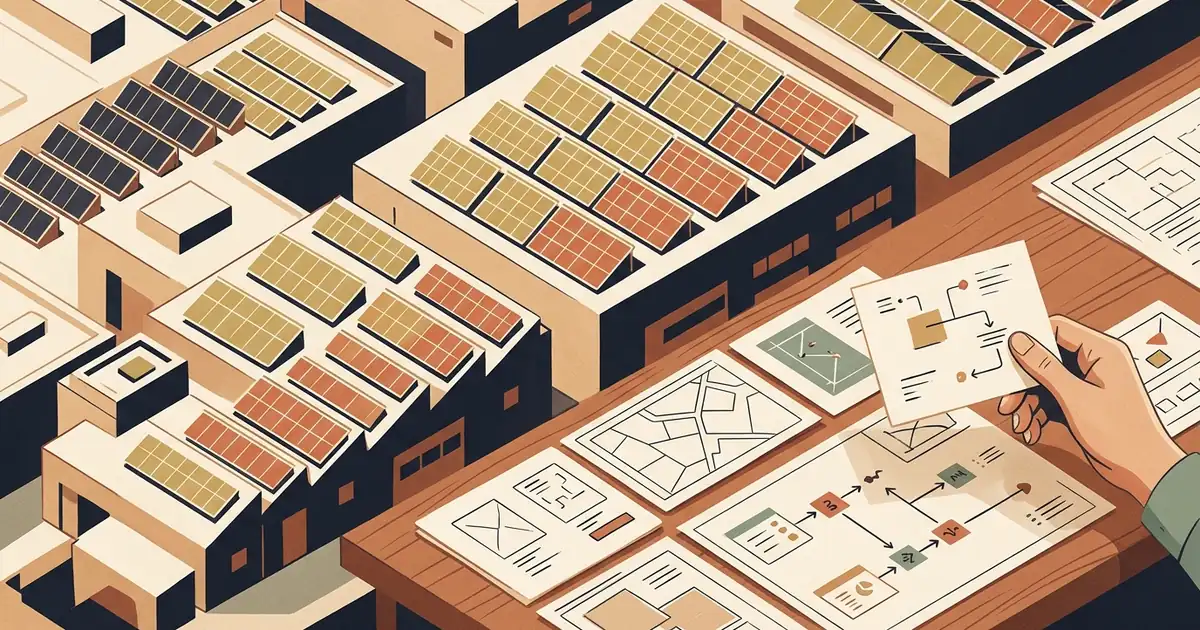
Most independent installers rely on two lead sources: word of mouth, which makes revenue unpredictable, and shared lead marketplaces, which are getting expensive.
A portal lead costs 40 to 80 euros. Three or four other local companies get the same phone number at the same moment. By the time you call, the conversation is already about price, and nobody has looked at the electrical panel yet.
Meanwhile, within half an hour of your warehouse, industrial units, logistics buildings and agricultural facilities sit with more than 500 m² of clear roof. Their owners pay large commercial electricity bills every month, and no one has shown them a proposal built around their own building.
This is how small installation companies use cadastral data, aerial imagery and AI to build an exclusive pipeline of commercial rooftop projects.
Why bought leads are a bad deal
Commercial self-consumption brings higher margins, more predictable schedules and larger battery add-ons than residential work. But facility managers and operations directors rarely fill in a web form.
Manual prospecting fails for two reasons:
- Researching a single building (Google Maps, cadastral reference, company name, roof area) takes around 45 minutes.
- A generic cold email (“we install solar panels, ask for a quote”) ends up in spam or in an assistant’s trash folder.
To get an owner’s attention, your first contact has to contain numbers about their building: usable surface, installed capacity, expected annual production, payback period.
Doing that by hand for 200 buildings takes weeks. With open geodata and AI, it takes an afternoon.
The pipeline, in four steps
Industrial cadastral data + aerial orthophotos (PNOA)
                    ↓
AI vision (obstacles and usable surface)
                    ↓
Sizing engine (kWp, annual kWh, payback)
                    ↓
Personalized postal letter or direct email to management
1. Find the roofs with cadastral data
Most countries publish parcel data. Spain has the Sede Electrónica del Catastro and the PNOA orthophotos; France has the Cadastre IGN; similar datasets exist across Europe.
Instead of browsing at random:
- filter parcels by use: warehouses, manufacturing, logistics, retail;
- set a minimum roof size, for example 500 m²;
- pull the cadastral reference, the address and the building polygon.
This removes residential buildings and leaves only commercial targets.
2. Measure the roof with AI
Store the addresses in a working database (NocoDB is enough). A vision script then reads the aerial image:
- obstacles: skylights, extraction machinery, chimneys, structural shading;
- usable surface: net square meters after subtracting what cannot take panels;
- orientation and tilt: south, east-west, flat.
From the usable surface you get a capacity estimate. A 1,000 m² warehouse with 70% usable roof fits roughly 350 modules of 450 to 550 W, or 150 to 190 kWp.
Using local irradiance data (PVGIS in Spain, similar tools elsewhere), the system estimates annual production and compares it with typical commercial consumption profiles.
3. Write a specific proposal
Instead of a generic flyer, generate a two-page brief per building:
- an aerial image with their roof outlined;
- the sizing estimate (“Estimated potential: 160 kWp / 235,000 kWh per year”);
- conservative money figures: electricity cost reduction, payback (usually 3 to 5 years in industry), available tax deductions;
- a QR code and phone number to request a full technical study.
Connecting your database to an AI writing tool produces hundreds of these documents in minutes, with no manual data entry.
Once the lead sends their bills, see our guide on preparing solar quotes with AI to turn it into an engineering proposal and a bill of materials in under 30 minutes.
4. Send it on paper
Business inboxes are full of automated prospecting. A printed letter on the desk gets read.
Cloud print APIs (Pingen in Europe) send the generated PDF straight to print, fold, envelope and delivery through the national postal carrier.
A few practical rules:
- address it to “General Management” or “Facilities & Operations Director”;
- include the building address and the company name;
- under GDPR, business postal mail to a commercial address falls under legitimate interest, so it avoids the opt-in rules that block cold email.
The cost is minimal: with Pingen, each printed and posted letter costs less than €1 (a few cents more in colour). A hundred personalised letters cost under €100, the price of one or two portal leads, and a letter built around the owner’s own building gets a far higher response than mass email.
Connect the lead to your workflow
When the owner scans the QR code or calls, the record should already exist in your system.
- The cadastral reference, roof calculation and aerial image are there.
- Your salesperson does not start from zero: they know the roof size, orientation and power bracket.
- With STEL Order or Odoo, a webhook can pre-create the customer and project file, as described in our guide on STEL Order and Odoo AI automation for solar.
The numbers
| Shared marketplace leads | Your own rooftop pipeline | |
|---|---|---|
| Cost per lead | €40 to €80 per contact | Under €1 per letter sent |
| Exclusivity | Shared with 3 to 5 installers | Yours only |
| Typical project | Residential, 3 to 8 kWp | Commercial, 50 to 500 kWp |
| Price pressure | High, the client is comparing quotes | Low, you lead the technical conversation |
| What you own | Nothing, you rent access | A verified regional database |
Building your own pipeline changes your position. You stop waiting for the phone to ring or buying overpriced contacts, and you start choosing the best roofs in your area.
If you want to implement this alongside other non-competing solar founders, explore our AI training for solar installers and see how we configure these workflows step by step.
Frequently asked questions
Why is targeted B2B rooftop prospecting better than buying marketplace leads?
Marketplace leads are sold to 3 to 5 installers at the same time, triggering a race to the bottom on price. High-capacity commercial and industrial roofs (warehouses, logistics hubs, agrifood factories) rarely submit forms on comparison portals. Finding them through cadastral data gives you exclusive, uncompeted access to high-margin commercial projects.
How does AI analyze roofs without an on-site visit?
AI scripts process high-resolution aerial orthophotos (such as PNOA in Spain or national geographic survey databases) combined with cadastral footprints. The vision model identifies roof orientation, tilt, surface obstacles like skylights and HVAC units, and estimates net usable area for photovoltaic panels.
Is sending automated postal letters legal under European data privacy rules (GDPR)?
Yes. In most European jurisdictions, postal mail addressed to a generic corporate title (such as 'To the General Management' or 'Attention: Facilities Manager') at a registered commercial facility constitutes legitimate business interest under GDPR without requiring pre-existing opt-in email consent.
How long does it take to set up this lead workflow?
A basic pipeline using open GIS data, an automated database like NocoDB, and an AI letter generator takes one to two weeks to configure. Once operational, qualifying an entire industrial area takes less than an afternoon.
Want this inside your own business?
Simple AI Studio runs a hands-on implementation bootcamp for founders and small teams. You leave with a working AI system, not slides.