Solar installers
AI and Solar Subsidies: How Installers Can Prepare Documentation Without Administrative Chaos
By Samuel Michelot · Updated July 2026
Short answer
Solar installers spend up to 40% of their administrative time assembling regional grant and subsidy applications. By using AI to extract technical data from property registries, cross-check regional eligibility criteria, generate standardized justification reports, and prepare missing-document checklists for homeowners, installation teams can cut document preparation time from 90 minutes to under 15 minutes per customer.
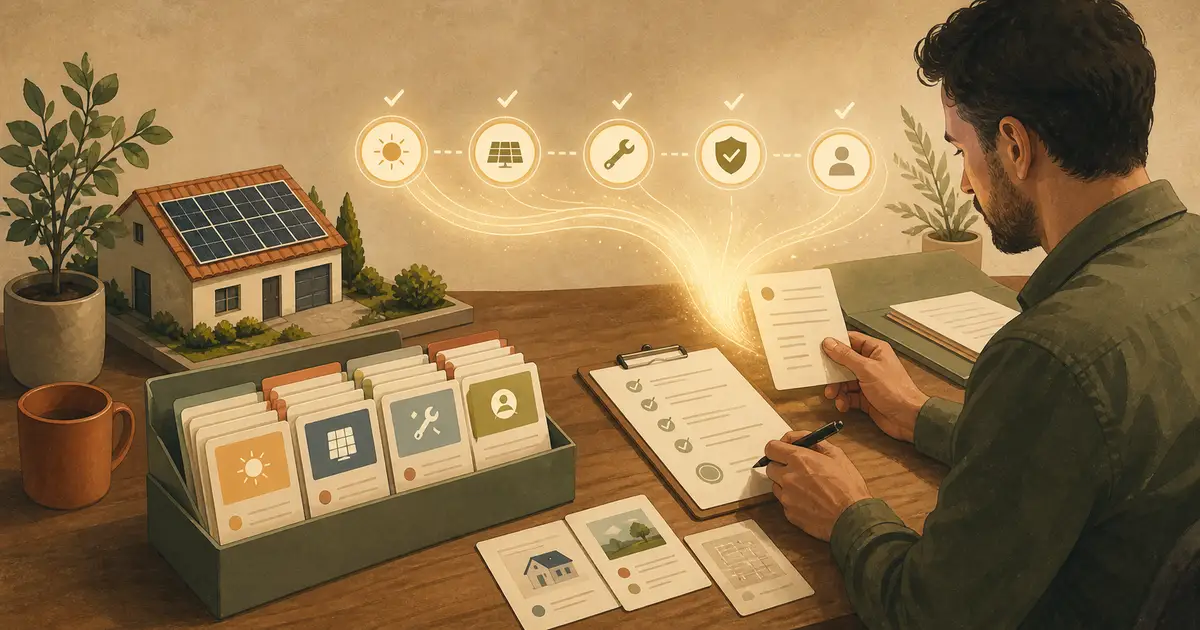
Ask any residential or commercial solar installer what slows their business down, and the answer is rarely the technical installation on the roof.
The real bottleneck is the mountain of paperwork required for regional solar subsidies, tax rebates, and municipal permits.
Between municipal tax reductions, regional energy agency grants, and European recovery funds, every single installation requires a dozen distinct forms, property registry certificates, energy performance certificates, and customer authorizations.
When a small solar company installs 15 to 30 systems a month, administrative staff can easily spend 30 to 45 hours every week just assembling subsidy folders.
Here is how modern solar companies use simple AI workflows to eliminate subsidy bottlenecks and get documentation approved without administrative chaos.
The 4 Main Bottlenecks in Solar Subsidy Processing
- Document Hunting: Chasing customers for missing property tax receipts, identity cards, and utility bills.
- Data Extraction: Manually copying cadastral reference numbers, roof surface areas, inverter serial numbers, and kilowatt-peak ratings into municipal templates.
- Regulatory Variance: Different municipalities offer different property tax rebates (such as IBI reductions in Spain or local tax credits in France) with varying eligibility criteria.
- Formatting Errors: Rejections caused by minor typos in owner names, addresses, or missing technical attachments.
The AI Document Assembly Workflow
Step 1: Automated Client Document Verification
When a customer sends photos or PDFs of their utility bill, property tax receipt, and identity document, an AI assistant analyzes the bundle against a standardized intake checklist.
The model checks:
- Is the cadastral reference clearly legible?
- Does the name on the electricity bill match the property deed?
- Is the contracted power rating high enough for the proposed solar system?
If any document is missing or expired, the AI drafts a friendly, customized WhatsApp or email message explaining exactly what is needed and why.
Step 2: Extracting Technical Data from Cadastral and Quote Files
Rather than typing numbers manually, administrative staff drop the final technical proposal and property registry document into their AI workspace.
Using a standardized prompt, the AI extracts and formats:
- Client full legal name and tax ID.
- Cadastral reference and installation coordinates.
- Total peak solar power (kWp) and estimated annual generation (kWh).
- Inverter model, battery capacity, and panel counts.
The output is formatted directly into the exact table structure required by the regional subsidy portal.
Step 3: Generating the Technical Justification Report
Most public grants require an explanatory memorandum explaining energy savings and environmental impact.
The AI takes the system dimensions and automatically drafts the standardized justification text, calculating:
- Estimated annual CO2 emissions avoided.
- Percentage of self-consumption versus grid export.
- Payback period before and after regional grant incentives.
An administrative manager reviews the generated report in 60 seconds, signs off, and attaches it to the application.
The Single Source of Truth: The Subsidy Rulebook
The biggest trap in solar subsidy management is relying on memory for changing regional rules.
Instead, create a simple Markdown document for each municipality and autonomous region you serve:
- Maximum eligible subsidy percentage.
- Mandatory deadlines from installation date.
- Required engineer signatures and certification levels.
Whenever the regional official gazette updates subsidy conditions, you update that single text file. Your AI models immediately reference the updated criteria for every subsequent customer file.
Next Steps
To train your operations and administrative team on these automated workflows, explore our AI training for solar installers program.
To see how AI improves your sales cycle before the subsidy phase, read using AI to prepare better solar quotes and following up with solar customers using AI.
Learn more about organizing your company documents in our guide on why SOPs come before automation.
Frequently asked questions
Can AI automatically submit subsidy applications to public administration portals?
No, and attempting to do so is high risk. AI should be used to extract, verify, draft, and assemble all required technical and personal paperwork. The final verification and official digital certificate submission should always remain in the hands of an administrative team member.
How does AI handle frequent changes in regional solar subsidy regulations?
By maintaining a single regional regulation markdown sheet in your local second brain. When local subsidy terms or tax credit percentages change, you update one document, and all subsequent AI document drafts immediately adhere to the latest rules.
What types of solar documentation can AI prepare most effectively?
AI excels at extracting data from utility bills and cadastral certificates, generating technical justification summaries, drafting client authorization letters, and compiling customer-facing checklists of missing tax certificates.
Does this require specialized software or can we use standard AI tools?
You can implement this workflow entirely using standard multimodal AI models (such as Claude or GPT-4o) alongside a well-structured folder of document templates and standard operating procedures.
Want this inside your own business?
Simple AI Studio runs a hands-on implementation bootcamp for founders and small teams. You leave with a working AI system, not slides.