Founder leverage & less stress
Do Not Automate Because AI Is Impressive. Automate Because This Task Is Expensive.
By Samuel Michelot · Updated June 2026
Short answer
Stop asking what your hour is worth in theory. Ask what a specific repeated task costs your business in real friction, delays, and context-switching. Evaluate tasks using a 7-factor Automation Score to target high-frequency, high-interruption bottlenecks with easy verification before writing a single line of automation.
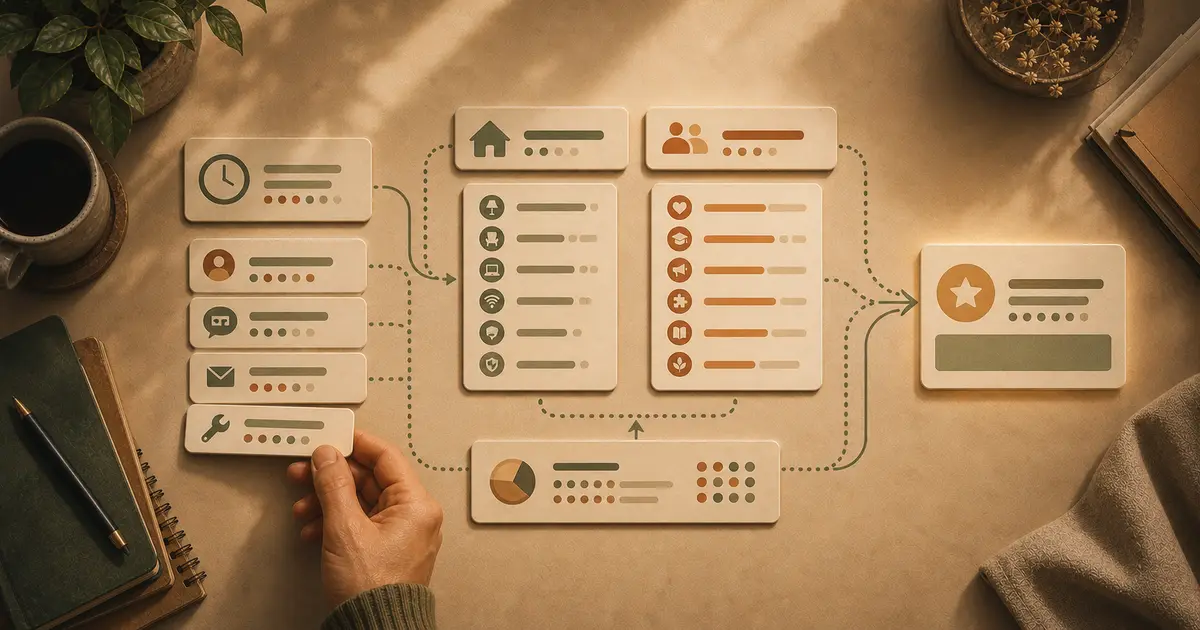
The most expensive work in a small business is often not the work that takes the longest. It is the work that interrupts the right person.
When founders and operators evaluate AI tools, they usually get distracted by abstract vanity metrics like “calculating your ideal hourly rate.” Then they spend three days trying to automate a quirky task they only perform once every two months.
The correct question is not “How much is my hour worth?” It is “What does this repeated task cost the business right now, and what would change if it disappeared?”
Do not automate because a demo looks impressive. Automate because an operational bottleneck is bleeding time, delaying revenue, and draining your best people.
The 7-Factor Automation Score
Before you build an automation or introduce an AI assistant, score the task across these seven operational factors:
- Frequency: How many times per week does this task occur? (Daily = High, Monthly = Low)
- Minutes per Instance: How long does it take from start to finish?
- People Involved: How many handoffs occur between team members?
- Cost of Delay: What happens if this task sits waiting for 24 hours? Does a hot lead go cold, or does an installer sit idle?
- Error Risk: What breaks if there is a mistake? Is it easily corrected, or does it create a financial liability?
- Ease of Review: Can a human verify the finished output in under 30 seconds?
- Strategic Value of the Operator: Is the person doing this task your lead salesperson, your senior engineer, or the founder?
A high-leverage automation candidate has high frequency, high interruption cost, high strategic operator value, and fast verification.
The Operational Worksheet: 3 Small Business Cases
Look at how three common small business tasks compare under this framework:
Case 1: Replying to Repetitive Customer Questions
- Daily Reality: Prospects ask the same 8 questions about warranties, permits, and installation timelines across email and WhatsApp.
- Interruption: The sales lead stops deep work 6 times a day (10 minutes each = 60 minutes daily).
- Cost of Delay: High. Prospects contact three competitors; the fastest clear response usually wins the initial call.
- Ease of Review: Very fast. A human glances at the drafted response, verifies the property address, and clicks send in 15 seconds.
- Decision: Automate First. Draft replies automatically from your company knowledge base, with mandatory one-click human approval.
Case 2: Preparing Standard Sales Proposals
- Daily Reality: Copying technical project notes from site surveys into a quote template, calculating equipment totals, and writing the summary letter.
- Interruption: 45 minutes per proposal, 5 times per week.
- Cost of Delay: Medium to High. Slow proposals stall the sales pipeline.
- Ease of Review: Moderate. Requires checking component counts and final margins against pricing sheets.
- Decision: Document and Automate. Create a structured instruction file (
AGENTS.md) and standard template first, then let AI assemble the draft for sales review.
Case 3: Collecting Information Before a Founder Decision
- Daily Reality: Pulling project status reports, subcontractor invoices, and material receipts before approving payment.
- Interruption: The founder spends two hours every Friday chasing documents across email threads and folders.
- Cost of Delay: Low immediate risk, but high cognitive drag.
- Ease of Review: Instant once gathered.
- Decision: Standardize and Delegate. Create a single intake folder or form before applying any AI tool.
Which Tasks You Should NOT Automate First
Save your energy by avoiding these common automation traps:
- Unstable, Changing Processes: If your pricing model or delivery steps change every fortnight, automating them will lock in chaos.
- Rare Exceptions: If a situation happens once a quarter, write a simple note in your Second Brain and handle it manually.
- High-Touch Relationship Closing: The personal phone call that establishes trust with a key commercial client should never be replaced by an automated bot.
A Simple Payback Sanity Check
You do not need a complex financial spreadsheet to justify an automation project. Use this simple rule of thumb:
$$\text{Monthly Hours Recovered} = (\text{Frequency per Month}) \times \left(\frac{\text{Minutes Saved}}{60}\right)$$
If an automation saves 15 minutes on a task done 20 times a month, you recover 5 hours every month. If documenting and setting up the workflow takes 3 hours, your system pays for itself in less than three weeks. More importantly, it removes 20 context switches from your key operators.
Before you build anything, make sure the underlying process is solid. Follow our D.A.D. + V framework to delete unnecessary steps, consult our guide on why SOPs come before automation, and track real impact with our methodology for measuring if AI saves time.
Bring one repeated task from your daily business. We will decide whether to delete, document, automate, or keep it human in a practical AI training for founders and operators. We help you eliminate operational friction and install workflows that give you real leverage.
Frequently asked questions
Why is task interruption more expensive than task duration?
When a senior technician or founder is interrupted for 10 minutes to format a document or look up supplier data, they lose 20 additional minutes recovering their focus. The true cost is not the 10-minute task, but the delayed strategic decisions and fragmented focus that follow.
Which tasks should never be automated first?
Never automate tasks that occur less than once a month, processes that lack stable operational rules, or high-stakes relationship conversations where personal trust closes the sale. If a process cannot be written as a clear checklist, automating it will only accelerate mistakes.
How do we calculate the payback period of an automation without complex accounting?
Compare the setup and documentation time against monthly hours recovered. If standardizing and automating a proposal draft takes 6 hours to build, and it saves your sales lead 4 hours every single week, your payback period is less than two weeks.
What role does ease of review play in automation decisions?
Ease of review is critical. If verifying the AI output takes as long as doing the task manually from scratch, the automation provides zero operational leverage. Target tasks where a human can verify correctness in under 30 seconds.
Want this inside your own business?
Simple AI Studio runs a hands-on implementation bootcamp for founders and small teams. You leave with a working AI system, not slides.