AI training for small business
How to train a small team in AI without losing weeks in theory
By Samuel Michelot · Updated June 2026
Short answer
Train on real work, not theory. A few short sessions, each person working on one of their own tasks during the session, and everything that works saved into shared prompts and context documents. The goal isn't for them to talk about AI, but to finish the week with a task done faster.
A lot of AI training fails for the same reason: it teaches tools and concepts but leaves nothing the team uses the following Monday. Two days of slides, plenty of motivation, and two weeks later everything is back to how it was.
For a small team there’s a much better approach, and it’s almost the opposite of a classic course.
Train on real work, not theory
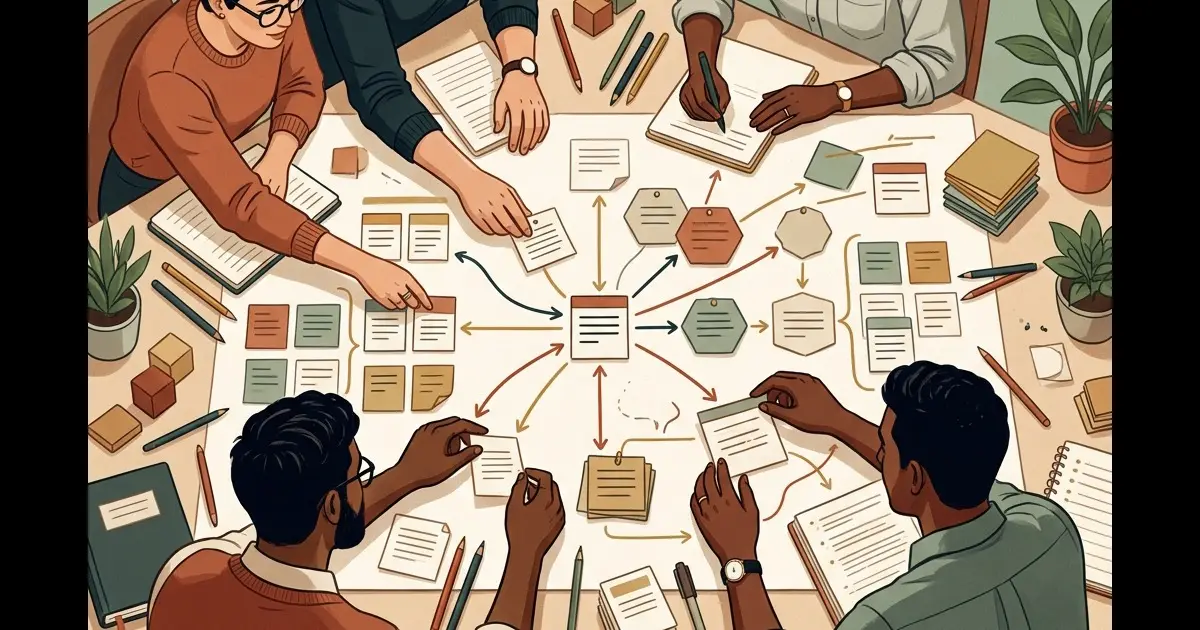
The main rule: during the session, each person works on one of their actual tasks. Not an invented example, not an “imagine that…”. Their real email, their real quote, their real report.
That changes everything. People don’t remember a lesson on “what a language model is”. They remember the day they finished in ten minutes something that used to take an hour. Learning anchors to the result, not the explanation.
Few short sessions, not a marathon
A two-day intensive produces a spike of enthusiasm and little habit. It works better to spread training across a few short sessions over several weeks, with real tasks in between.
A rhythm that works well:
- Session 1: everyone picks one of their repetitive tasks and does it with AI, live.
- Between sessions: they apply it to their normal work and note what breaks.
- Session 2: you solve the real blockers that appeared, not the theoretical ones.
- Later sessions: you level up toward context, templates and, if it makes sense, first agents.
The space between sessions is where the real learning happens, because it forces people to use AI in their normal workflow.
Start with context, not prompts
The most common mistake when training a team is teaching “prompt tricks”. They help little if the AI doesn’t know the business. Before chasing the perfect prompt, it’s better to gather the company’s context (tone, prices, terms, typical mistakes, good examples) into documents the AI can read.
With good context, simple prompts give good results. Without context, even the best prompt can’t save a generic answer. That’s why the first step is usually building that shared context. If you haven’t chosen which tasks to start with, this guide on how to identify your first AI use cases helps you decide.
Keep the result in the company, not in a person
Training that only lives in the head of whoever attended is fragile: that person leaves, and the knowledge leaves with them. The fix is simple: everything that works gets saved.
Every useful prompt, every context document, every mini-procedure goes into a shared space. The team then builds, almost without noticing, its own small AI system. That’s what really remains after the training: not notes, but reusable assets.
Measure in time, not enthusiasm
Post-training enthusiasm is misleading. The honest metric is time: which tasks now get done faster, and at what quality? It’s enough for each person to pick one or two tasks and compare “before” and “after” in minutes.
If the team ends the week with real tasks done faster and a handful of saved prompts that work, the training did its job. If it ends only with good vibes, it didn’t.
Where to go next
To see the full bootcamp format designed exactly this way, look at the AI training for small business page. And when the team starts testing tools, this comparison of ChatGPT, Claude or Gemini for a small business helps you not get lost between options.
Frequently asked questions
How many sessions does a small team need?
Few and short beats one long course. Four guided working sessions, spread over several weeks, with real tasks in between, leave more behind than two intensive days of theory nobody applies afterward.
What if the team has barely used AI?
That's fine, as long as they're curious and ready to apply. Training starts on their own tasks from day one. What doesn't work is treating it as a slow beginner course: you learn by doing, not by listening.
How do you stop everything being forgotten after the training?
By saving what works. Every useful prompt and context document stays in a shared space. The knowledge then lives in the company, not in the head of one person who eventually leaves.
Want this inside your own business?
Simple AI Studio runs a hands-on implementation bootcamp for founders and small teams. You leave with a working AI system, not slides.