AI agents & Codex work
Your AI Is Generic Because Your Business Knowledge Is Scattered.
By Samuel Michelot · Updated June 2026
Short answer
If your AI assistants produce bland, robotic text, the model is not the problem. The problem is lack of company context. A business Second Brain organizes your operating rules, standard procedures, customer personas, and technical specifications into plain Markdown files. When AI assistants read your Second Brain, every proposal, email draft, and analysis reflects your exact standards.
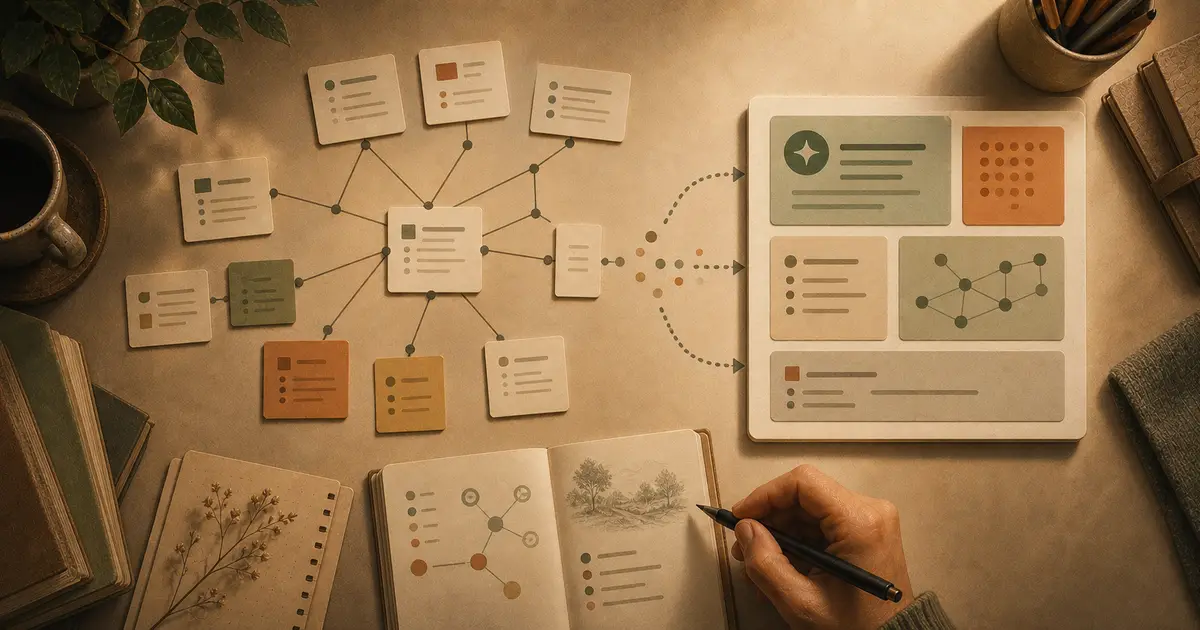
When an AI gives generic, robotic advice, the problem is almost never the model. The problem is that your business context lives in people’s heads, buried in chat apps, or lost across unsearchable shared drives.
Without your company context, even the most capable AI model behaves like a temporary contractor who arrived ten minutes ago. It produces polite, bland paragraphs that could belong to any competitor in the world.
A small business Second Brain is not an academic personal diary. It is an operational context layer stored in plain Markdown files that human team members and AI assistants can both access instantly.
When your business knowledge is structured and accessible, AI stops sounding like a generic robot and starts executing like your best trained operator.
What Belongs in a Business Second Brain vs What Stays Out
Keep your system clean by establishing clear boundaries from day one:
What Belongs Inside:
- Operating Rules & Criteria: How your business makes pricing, warranty, and discounting decisions.
- Standard Operating Procedures (SOPs): Step-by-step checklists for recurring tasks (onboarding, invoicing, quotes).
- Customer Profiles & Personas: Real objections, target client profiles, and common purchase triggers.
- Product & Technical Reference: Equipment compatibility, local municipal regulations, and approved component lists.
- Approved Templates & Past Wins: Winning proposal excerpts, email follow-up cadences, and successful project summaries.
What Stays Out:
- Passwords & API Secrets: Keep credentials in dedicated password managers (e.g., 1Password, Bitwarden).
- Confidential HR & Medical Records: Private personnel files belong in secured payroll/HR systems.
- Raw Chat Logs: Ephemeral conversations from WhatsApp or Slack should only enter if distilled into an actionable SOP.
The Minimal 4-Folder Business Structure
You do not need a complex organizational theory. Start with this simple 4-folder architecture:
📁 Business-Second-Brain/
├── 📁 0 Context/      ──> Company mission, target customers, brand voice
├── 📁 1 SOPs/         ──> Step-by-step procedures and checklists
├── 📁 2 Reference/    ──> Technical specs, pricing sheets, supplier directories
└── 📁 3 Archive/      ──> Completed project reviews and outdated notes
1. 0 Context/
Contains 2 to 3 foundational notes explaining your company value proposition, ideal client profile (ICP), and tone guidelines.
2. 1 SOPs/
Contains numbered, actionable procedures. Each note defines a trigger, step-by-step instructions, and a clear verification checklist.
3. 2 Reference/
Stores static information the team frequently looks up: technical specifications, local tax rebate rules, warranty terms, and approved supplier catalogs.
4. 3 Archive/
Holds completed project post-mortems and superseded documents so active folders remain clean and uncluttered.
The Bridge: How Second Brain Notes Connect to AGENTS.md
Your company instruction file (AGENTS.md) is the master brief for your AI tools. Instead of cramming 50 pages of instructions into one giant prompt, AGENTS.md references specific notes in your Second Brain:
# AGENTS.md (Excerpt)

When drafting a residential solar proposal:
1. Check technical sizing rules in `2 Reference/Inverter-Compatibility.md`.
2. Follow the proposal drafting sequence in `1 SOPs/SOP-Solar-Quote-Generation.md`.
3. Adhere to our brand voice guidelines in `0 Context/Company-Voice.md`.
When an AI agent or a new employee opens your workspace, they have instant access to verified, up-to-date company standards.
Two Small Business Realities
Case 1: The Solar Installation Company
- Before: Technicians answered the same mounting questions repeatedly. Proposals mixed up roof attachment brackets across tile and flat roofs.
- With a Second Brain: Folder
2 Reference/contains exact bracket models per tile type. Folder1 SOPs/contains the site survey checklist. AI drafts technical proposals referencing the exact mounting hardware in seconds.
Case 2: The B2B Consulting Agency
- Before: Every client onboarding was reinvented from memory. Discovery questions were lost in email threads.
- With a Second Brain: Folder
0 Context/defines client personas. Folder1 SOPs/contains a 7-step client kickoff SOP. AI drafts customized intake summaries and project agendas directly from client call notes.
The 5-Day Team Setup Plan
You can install a fully functional Second Brain in one business week:
- Day 1: Setup the Workspace: Create a shared Obsidian vault on your internal drive and create the 4 minimal folders.
- Day 2: Write Company Context: Draft your 1-page business overview, ideal customer profile, and tone rules in
0 Context/. - Day 3: Document Top 3 SOPs: Write clear checklists for your three most common repeated tasks in
1 SOPs/. - Day 4: Build the Bridge: Create your company
AGENTS.mdfile pointing to your new SOPs and reference notes. - Day 5: Execute First Live Test: Use an AI assistant to draft a client email or proposal using the Second Brain context, review the output, and refine.
To learn how to structure your executive instruction file, read our complete guide on how to write your company AGENTS.md brief.
If your team has this problem, this is what we work on in a practical AI agent and business Codex training. We help you organize your company knowledge, build a durable Second Brain, and install AI workflows that give your team genuine operational leverage.
Frequently asked questions
Why use plain Markdown files in Obsidian instead of Notion or Google Docs?
Plain Markdown files (`.md`) are future-proof, open, and stored locally on your own computer or server. They do not lock your data into a proprietary database. Crucially, AI coding agents and local tools can read, search, and edit plain text files instantly with zero API friction.
What should NEVER be stored in a business Second Brain?
Never store passwords, raw API secrets, banking credentials, or sensitive employee medical records in shared operational notes. Restrict your Second Brain to business procedures, reference data, customer personas, and operating criteria.
How does a Second Brain connect to our company AGENTS.md file?
Your `AGENTS.md` file acts as the executive brief that tells AI agents who you are and where to look. When an agent needs to draft a customer follow-up or check technical sizing, `AGENTS.md` points it directly to the exact procedure note inside your Second Brain.
How much time does a team need to maintain a business Second Brain?
After a 5-day initial setup, maintenance takes 10 to 15 minutes a week. You do not create elaborate academic note hierarchies. You simply document new operational decisions and update procedures whenever a process changes in real life.
Want this inside your own business?
Simple AI Studio runs a hands-on implementation bootcamp for founders and small teams. You leave with a working AI system, not slides.